
Food Industry
By implementing resource flow strategies and circular economy management, you can review how your waste and wastewater can be transformed into useful resources. Managing and transforming waste and wastewater can reduce costs, minimize negative environmental consequences, and create economic benefits.
Showing your commitment to sustainability and the circular economy can also improve your brand’s reputation and attract customers who are more aware of environmental issues.
Food Industry
By implementing resource flow strategies and circular economy management, you can review how your waste and wastewater can be transformed into useful resources. Managing and transforming waste and wastewater can reduce costs, minimize negative environmental consequences, and create economic benefits.
Showing your commitment to sustainability and the circular economy can also improve your brand’s reputation and attract customers who are more aware of environmental issues.
Let your waste and wastewater be part of your core business – it’s to your advantage!

It is important to investigate and analyze which specific opportunities suit your business best. We are experts in this field and can help you maximize the benefits and minimize the risks.
Challenges
The food chain is vulnerable. It needs to become more robust to withstand different types of crises. Therefore, a circular food industry is a necessity. A precondition for achieving a more circular food industry is to take care of the underutilized resources present throughout the food chain.
Our solution
EkoBalans helps you identify and find greater value in the waste streams that come from food production. Through an investment in our processing plant, the streams are treated with our solutions eco:P, eco:N and eco:S to capture nutrients and organic material. The extracted fractions can then be purchased from us for use as raw materials in our production of fertilizers and soil improvement products.
The result
Our solutions lead to new and better business, reduced climate impact, and contribute to increased self-sufficiency.
Food Industry
What is commercial fertilizer?
Commercial fertilizer is produced from finite natural resources and through a method that consumes large amounts of fossil energy. It contains the same plant nutrients as natural fertilizers: nitrogen, phosphorus, and potassium. The difference is that they consist of easily soluble salts that plants readily absorb. Because the plant nutrients are easily soluble, they can also be easily washed away by rainwater into nearby water bodies, causing eutrophication, which leads to dead zones, toxic algal blooms, and overgrown waterways. There needs to be a balance between the nutrients added and those removed from the field to avoid leaching of plant nutrients. Unfortunately, there are no restrictions on how much nitrogen and phosphorus can be spread with commercial fertilizers; it is solely based on the crop’s needs.
Commercial fertilizers have a significant climate impact due to greenhouse gas emissions during production and nitrous oxide emissions during use. Phosphorus and potassium are derived from finite natural resources, making commercial fertilizers not ecologically sustainable.
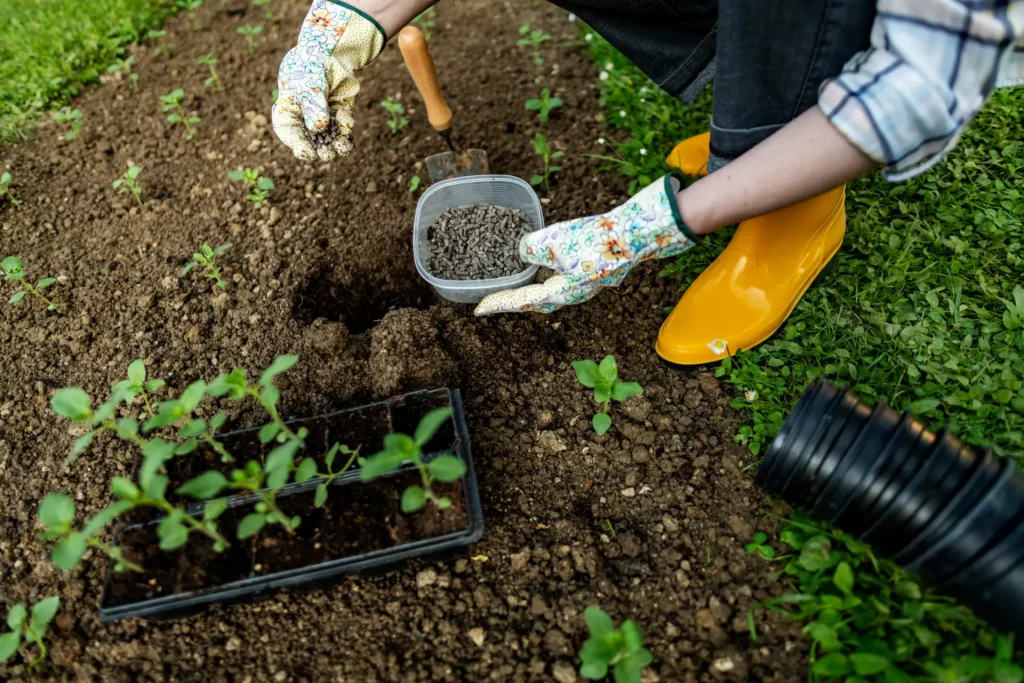
Food Industry
Let your waste streams replace commercial fertilizers
Today’s agriculture is largely dependent on commercial fertilizers, which are produced from finite resources and with the use of fossil energy. With the help of EkoBalans solutions, waste streams from the food industry can become valuable circular fertilizers that can replace commercial fertilizers.
Waste streams with high nutrient content are purified, concentrated, and treated with eco:P
and eco:N, where nutrients are recovered. The extracted nutrients can then be refined into locally produced organic fertilizers for more sustainable agriculture.
Read more about the technology for treating nutrient-rich wastewater.
Waste streams with low nutrient content, such as straw, can be treated with eco:S. The result is biochar, a soil enhancer with many positive properties.

Want to know more?
Contact us through phone or E-mail or fill out the form below